Project Overview
The Eastern Sierra Climate & Communities Resilience Project (ESCCRP) is a collaborative, landscape-scale effort led by Whitebark Institute, the Inyo National Forest, and local partners. This long-term initiative aims to restore forest health, reduce the risk of catastrophic wildfires, and improve ecosystem resilience across 65,000 acres in the Eastern Sierra.
Work begins in 2026, with initial work scheduled from May to November. These efforts will include mechanical thinning, hand thinning, and other restoration treatments focused on priority areas to enhance forest health and reduce wildfire risk. Due to the size and urgency of this project, temporary public access restrictions will be necessary at select roads, campgrounds, and trailheads during active operations.
Why is this project necessary?
Over the past century, the suppression of naturally ignited, low to moderate severity fires has led to an overgrowth of trees in Sierra Nevada forests. Now, when wildfires ignite, they burn hotter, faster and with more devastating consequences to both people and the ecological health of the area. Overcrowded trees also facilitate the spread of harmful diseases, including bark beetle infestations.
To learn more, visit our Forest Health page.
Project Timeline
Work will run from May through November. Project timeline may change due to environmental factors such as increased wildfire hazard due to hot and dry conditions. In some areas, mechanical thinning operations timeline will be influenced by soil moisture, as soil must be sufficiently dry to avoid compaction from heavy equipment.
Upcoming Work Schedule (subject to change)
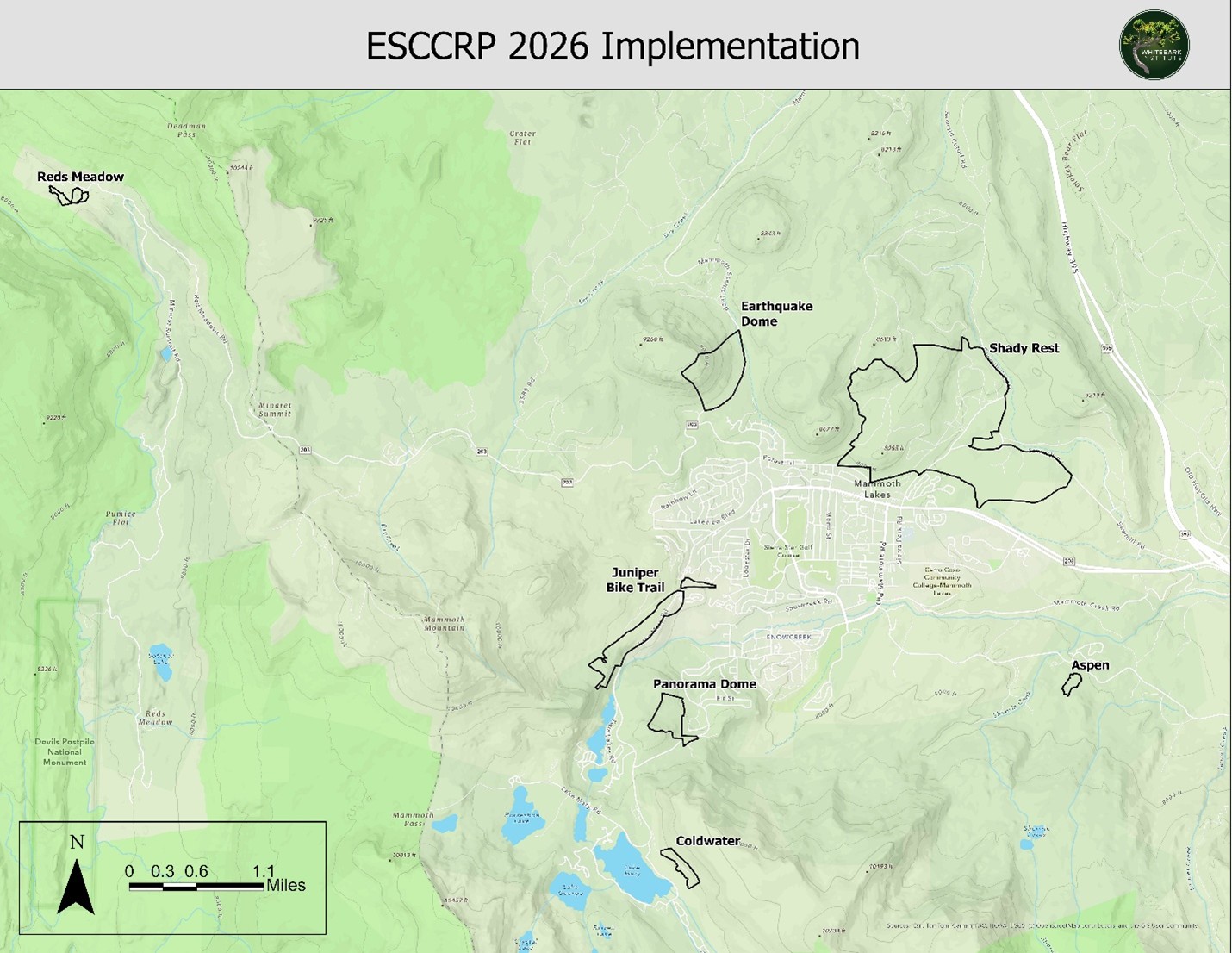
See map (below) for unit locations.
- Coldwater: May 4th – 29th
- Hand Machinery on site.
- Second phase of treatment: Understory thinning.
- Impacts: Trail delays and noise.
- Mammoth Mountain Juniper Bike Trail: May 13th – June 1st
- Mechanical and Hand Machinery on site.
- Treatment: Understory thinning, removal of standing dead and coarse woody debris, building burn piles, meadow restoration, and aspen restoration.
- Impacts: Forest Order Closure. No access to Juniper Bike Trail. Lake Mary Road and Juniper Road traffic delays on May 21-22.
- Shady Rest: May 24th – November 15th
- Mechanical and Hand Machinery on site.
- Treatment: Understory thinning, removal of standing dead and course woody debris, shrub removal, building burn piles, and limbing of trees along the road. Some logs will be hauled out from the unit.
- Impacts: Noise. Forest Order Closure. No access to trails. Potential traffic delays.
- Reds Meadow: June 1st – July 3rd
- Hand Machinery on site.
- Treatment: Agnew meadow restoration including conifer removal and thinning, removal of standing dead and course woody debris, building burn piles outside of the meadow.
- Impacts: Trail delays and noise.
- Panorma Dome: June 16th -20th
- Hand Machinery on site.
- Second phase of treatment: We have already cut down dead material and coarse woody debris which was burned in the winter 2025-2026. During this phase we’ll continue to cut trees to reduce stand density and build additional burn piles.
- Impacts: Forest Order Closure. No access to trails.
- Earthquake Dome: June 20th – June 29th
- Hand Machinery on site.
- Second phase treatment: Thinning of live trees and building burn piles.
- Impacts: Noise. No Forest Order Closure but other implementing partners (California Deer Association) will also be working along Scenic loop to cut down hazard trees and will have road closures.
- Aspen: September 1st – October 31st
- Hand Machinery on site.
- Treatment: Aspen restoration.
- Impacts: Noise
Public Impacts
Temporary public access restrictions will be necessary at select roads, campgrounds, and trailheads during active operations. We will do our best to update this page with upcoming closures as that information becomes available.
- Work Schedule & Hours: Work may be conducted between 5:00am-3:00pm from Monday to Saturday. Work near neighborhoods will begin at 7:00 am.
- Potential Disturbances: Noise, temporary road/trail closures, dust, and tree felling operations should be expected. In mechanical thinning units (Juniper Bike Trail and Shady Rest) heavy equipment will be utilized to fell and remove trees. Forest Order Closures will come into effect in some areas to protect public safety.
- Trailhead Closure Dates:
- Juniper Bike Trail: May 13th – June 1st
- Trail from Pinecrest Ave to just north of Sawmill Cutoff: May 11th -June 11th
- Panorama Dome Trail: June 16th -20th
- Shady Rest Disc Golf Course: more details coming soon.
- Road Closures Dates:
- Sawmill road: more details coming soon.
- 03S35 road: more details coming soon.
- 03S36 road: more details coming soon
- Forest Order Closures
- Closures will be in place in all units during active operations.
Maps
Community Resources and Staying Informed
In collaboration with project partners, Whitebark Institute will be hosting a community meeting on May 16th at the Community Center to discuss the ESCCRP and fuel reduction details with homeowners and community members. More details coming soon.
We will continue to update our website as details become available.
Defensible Space & Home Hardening BrochureFrequently Asked Questions
This project includes ecological forest thinning and fuels reduction to improve forest health and reduce high-intensity wildfire risk.
- Ecological forest thinning includes the removal of trees to restore historic forest composition and improve tree resilience. Trees selected for removal are those with low ecological value or that contribute to overcrowding, which weakens overall forest health
Fuels reduction focuses on removing understory trees that act as ladder fuels – vegetation that allows fire to climb into the forest canopy, increasing the risk of high-severity wildfire.
Depending on terrain and proximity to sensitive resources, some areas will be treated using hand thinning with chainsaws, while others may involve both mechanical and hand thinning:
- Hand thinning with chainsaws will be used in steeper areas or near sensitive resources, where mechanical equipment is not suitable.
- Mechanical thinning may involve skidders, feller bunchers, forwarders, masticators, and harvesters in areas where conditions allow for equipment use.
This project is designed to benefit wildlife and ecosystems in the long run by improving habitat conditions and reducing the risk of high-severity wildfire. While some temporary disturbances may occur, such as noise from equipment and smoke from pile burning, the work is guided by measures pre-determined by biologists and botanists in order to minimize impacts on wildlife.
Key habitat features—such as large trees, standing dead trees (snags), and downed logs—will be preserved to support wildlife that depends on them. Without action, wildlife faces greater risks from severe wildfires and widespread habitat loss due to tree mortality.
Before work begins, biologists will survey the area for wildlife, including nesting birds and species of conservation concern. If species are found, operations will be adjusted to protect them. These steps ensure that while short-term disruptions may happen, the long-term outcome will support healthier, more resilient forests and wildlife populations.
Not right away. While prescribed fire is a long-term goal, this project does not include broadcast burning. However, another approved plan allows the Forest Service to conduct prescribed burns in the future when conditions are suitable.
In the meantime, pile burning will take place after the project is completed. Smaller branches and felled trees that aren’t removed will be stacked into piles and burned once they have dried out (cured). This curing process reduces moisture content, which helps minimize smoke impacts and ensures a more efficient burn. By first reducing excess vegetation, we’re creating safer conditions for prescribed fire to be used effectively in the future.
This work is part of a larger effort to improve forest health and the risk of high severity wildfire across the Eastern Sierra. Rather than treating small, isolated areas, this approach considers the broader landscape, creating more effective fuel reduction that influences how future fires behave.
Most of the work is taking place within the Eastern Sierra Climate and Communities Resilience Project (ESCCRP), a 65,000-acre project area surrounding Mammoth Lakes. This project was analyzed under the ESCCRP Environmental Analysis, which was completed in 2024. Additionally, some units near the Sherwin Lakes Trailhead fall under the Sherwin-Scenic Environmental Analysis, completed in 2013, which addressed critical fuels reduction needs in the Mammoth area.
Together, these efforts build on past work and set the stage for future projects aimed at creating healthier, more resilient forests in the Eastern Sierra.
Currently, options for processing timber are limited in the Eastern Sierra and most of the felled trees and woody debris produced from landscape treatments have little commercial value.
Some of the fuels will be piled and left to cure for two years, after which they will be burned. Many of the larger logs will be removed from the project areas to reduce the quantity of fuels on the ground and local firewood companies will utilize the by-product. In the long term, Whitebark Institute and the Inyo NF are exploring innovative solutions for processing biomass.
At this time, there will not be any opportunities to collect wood from project areas. If wood is made available for collection, we will make sure the public is notified.
Please refrain from disassembling woody debris piles left in project areas for future burning. These piles are intentionally constructed to be easily located during winter when snow covers the ground and conditions are safest for burning. Disassembling the piles can make it extremely difficult for fire personnel to find them. Ensuring that these piles can be burned is essential to reducing woody debris on the landscape that contributes to greater fire hazard.
Decades of wildfire suppression have led to overcrowded forests, where too many trees compete for limited resources like water, sunlight, and nutrients. This competition weakens trees, making them more vulnerable to drought, pests, and disease.
Thinning some green trees helps reduce this stress, allowing the remaining trees to grow larger, healthier, and more resilient to future threats. If only dead trees were removed, forests would remain overcrowded, limiting their ability to recover and adapt to wildfire and climate change. This work is designed to restore more natural forest conditions and improve long-term forest health.
Although green trees will be removed, this project is designed to improve long-term carbon storage by promoting the growth of larger, fire-resistant trees. Right now, the forest is overcrowded with small trees that compete for water, sunlight, and nutrients, slowing overall growth.
By reducing tree density, the remaining trees can grow bigger and healthier, storing more carbon over time. It is anticipated that within about three years, the amount of stored carbon will be similar to pre-treatment levels. Additionally, reducing excess fuels lowers the risk of high-intensity wildfires, which release large amounts of carbon into the atmosphere. In the long run, this work helps forests store more carbon while becoming more resilient to wildfire and climate change.
Links and Additional Resources
Your donations support resilience and restoration in the Eastern Sierra
DONATE NOW